Scope
Scope
Adaptive will be implemented in phases, prioritizing foundational planning capabilities while establishing a scalable framework for future expansion. This strategy enables UIC to address priority needs, build organizational readiness, and support successful adoption before expanding to additional planning capabilities. Below is a visual representation of the modules with details underneath.
t
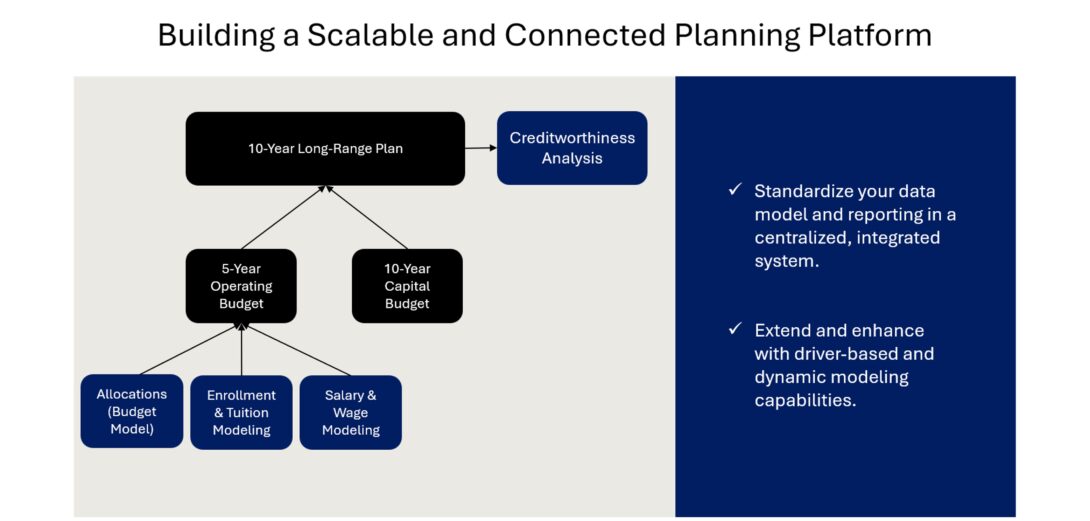
To learn more about each module, please click on the link below.
Phase 1 : Core planning modules
The initial phase focuses on three core planning areas that form the foundation of UIC’s integrated planning and forecasting environment. Together, these modules establish an integrated planning framework that connects operating, capital, and long-range financial planning within a single platform.
Five-Year Operating Budget
Establish a continuous, campus-wide budgeting and forecasting process that connects prior-year actuals, multiyear projections, and the annual budget. The module will support detailed revenue and expense forecasting, budget-to-actual comparisons, variance analysis, and timely adjustments as financial conditions change.
Ten-Year Capital Budget & Deferred Maintenance
Create a unified, long-term view of capital projects, deferred maintenance needs, funding sources, lifecycle costs, and debt-service obligations. This module will help UIC prioritize investments, evaluate funding strategies, and align capital decisions with institutional goals and long-term financial capacity.
Long-Range Ten-Year Financial Plan
Establish UIC’s first centralized and comprehensive long-range financial planning process. The module will integrate projected income statements, balance sheets, cash flows, revenues, expenditures, capital needs, and institutional assumptions, enabling leadership to evaluate how strategic and operational decisions may affect UIC’s long-term financial trajectory
Phase 2 : Advanced planning modules (Optional)
Enrollment and Tuition Revenue Planning
Integrate enrollment assumptions with tuition rates, credit hours, student levels, programs, waivers, refunds, and attrition factors to improve tuition revenue forecasting. This module will facilitate coordination among Finance, Enrollment Management, colleges, and other stakeholders while supporting drill-down analysis and scenario comparisons.
Salary and Wage Cost Impact Modeling
Provide a centralized framework for projecting workforce costs across union and non-union employee groups. The module will allow UIC to model compensation scenarios, staffing plans, salary increases, benefits, labor agreement provisions, and other cost drivers, with results incorporated into both the five-year operating budget and ten-year financial plan.
Creditworthiness Simulation and Ratings Management